

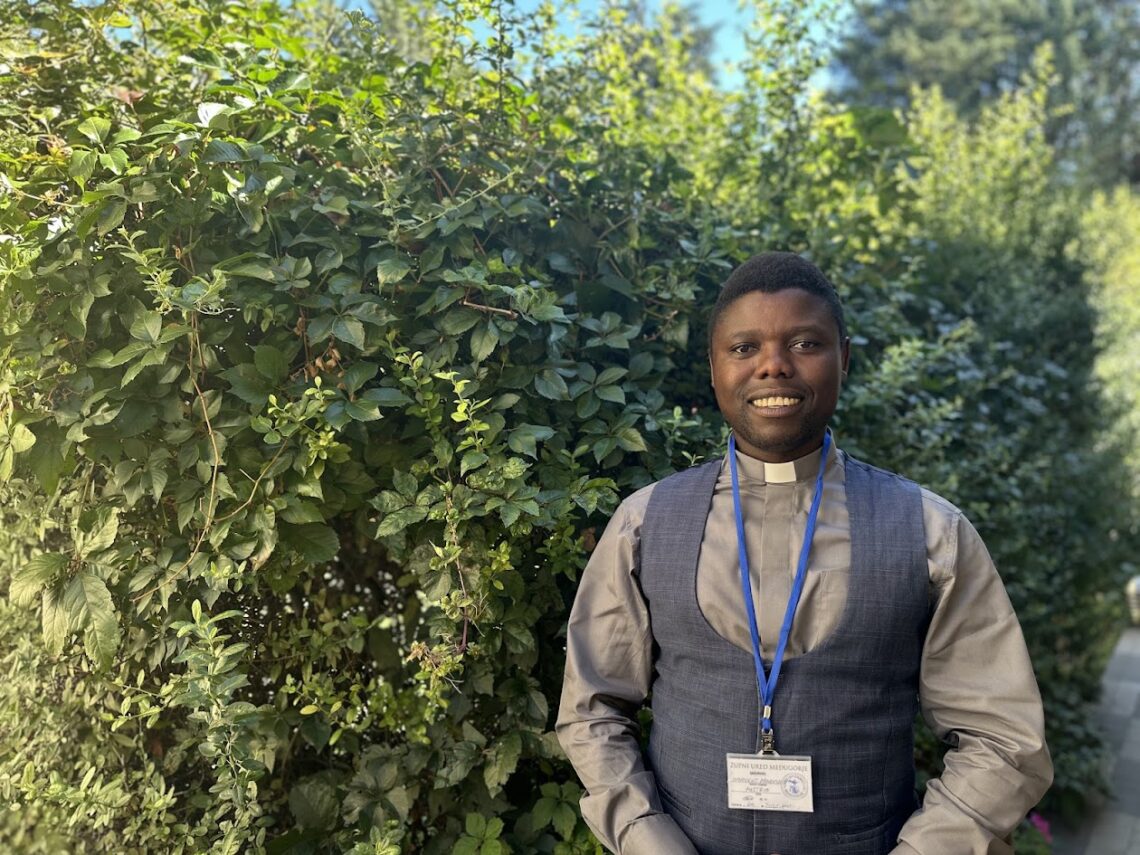
Some moments strike straight into the heart. Unplanned – and yet you feel immediately: they are guided. That is how it was for me when, one morning in Medjugorje, I sat in church lost in thought, and suddenly the voice and words of Innocent Mbarushimana awakened everything within me. Shortly afterwards, a coincidental encounter turned into a conversation that showed me how deeply faith, authenticity, and true testimony can touch. A story full of hope, healing, and vocation – one that can change your heart as well.
A morning I had not planned this way
That morning, I had not planned to go to early mass. I was tired from the beautiful days before and thought the evening mass would be better. Yet something inside me urged clearly: “Go now.” So I sat there in the church of Medjugorje – without great expectations, simply trying to focus.
And then something happened I had not expected. A priest I had never seen before began to preach: Innocent Mbarushimana. His words made me more awake, more attentive – they lifted me up inside. It was as if he spoke directly to me.
He said: “Medjugorje, Kibeho, Fatima, Lourdes, Guadalupe – these are not places for the perfect. They are places for the seekers, the wounded, the returning. You do not have to be perfect to be loved. You only need to be open. A small ‘yes’ is enough, and God can change your life.”
These words struck my heart. In January, during my eleventh visit to Medjugorje, I had experienced healing more than ever before. And now, in autumn, during my twelfth stay, this sermon gave me confirmation: God does not see us as fragments, but always as whole – and He makes something new and even better out of everything.
Encounter in the bookshop
After mass I had actually planned to go home. But something urged me: “Go to the German bookshop – Tiberias.” For years, this place has been special to me – inspiring, alive, full of encounters. Many times, I have met people there who touched me and led me further.
And so I stood there, browsing through the shelves, looking for a book – and just as I went to the counter to pay, the door opened. In came Innocent. At his side was Traude, whom he lovingly calls “Mama” – Traude Schröttner, a woman I knew nothing about until then. Later I learned that she has been active in Rwanda for decades, building schools and projects and giving countless people a future. A deeply impressive woman!
We all began talking – casually, almost by chance – and yet it was immediately clear: this was no coincidence. I felt I needed to learn more about these people. So we sat down in a café, and there Innocent began to tell his story – so open, so deep, that it captivated me from the very beginning.

Childhood & vocation
We ordered coffee, leaned back – and he began to tell his story. Not loud, not forceful, but with a quiet depth that immediately draws attention. His story took me to Rwanda, into his childhood.
Innocent Mbarushimana was born on December 19, 1990, one of eight children at the time. His mother died early. His father remarried, and Innocent eventually grew up in a family with eleven siblings. “My childhood was not easy,” he says softly. Poverty, loss, responsibility – these were formative experiences. Yet in the midst of this hardship there was one person who especially supported him: Father Ubald Rugirangoga, a well-known priest in Rwanda. He encouraged Innocent and urged him to follow his path.
Innocent attended high school in Cyangugu, a boys’ seminary – a time that shaped him. Afterwards, he entered the seminary. At first, after graduating, he wanted to study medicine. “I wanted to help people – perhaps as a doctor.” But Father Ubald told him: “If you become a priest, you can help even more people – not only physically, but also spiritually.”
These words burned into his heart. They gave him direction. Innocent decided to become a priest and went on to study philosophy (Bachelor) and theology (Master).
Priestly ordination & first tasks
In 2020 Innocent reached a decisive milestone: his priestly ordination. It was the moment when years of preparation, study, and struggle became a concrete mission. With the sacrament of ordination a new chapter began for him – no longer student, no longer seminarian, but priest for the people.
His first assignment took him as chaplain to a parish called Yove. There he accompanied the faithful, administered the sacraments, visited families, listened, and quickly became part of daily community life. But after only seven months, another mission followed: as bursar of the seminary at the same high school where he himself had once been a student – a boys’ seminary in Cyangugu. He now carried responsibility for administration and organization. A completely different role, one that challenged him but also helped him grow.
Yet his path was still not fixed. His bishop saw more in him and sent him to Nairobi, Kenya. There he was to complete a program in church administration – and at the same time prepare for something Innocent hardly dared to imagine at that time: “We want you also to study medicine – in Austria. But first you must learn German.”
The path to Austria
“I was afraid,” Innocent recalls. “German is a difficult language.” At the end of 2022 he nevertheless came to Graz – full of uncertainty, but also hope. For nine months he immersed himself in an intensive German course. “I prayed a lot and studied – it was a hard time.” Today, after three years, he speaks almost fluently – clear, precise, understandable. An impressive success – one can hardly believe he has only been learning German for three years.
His actual goal, the entrance exam for medicine in Graz, he did not pass at that time. “That was a disappointment,” he admits openly. But what seemed like a setback opened a new door. His bishop decided: “You shall study canon law – our diocese needs you there.”
Since Austria has no dedicated program for this, Innocent chose Munich. “I wanted to stay connected to Austria. I was welcomed there so warmly that it became like a second home for me.” Today he lives exactly in this rhythm: from Monday to Wednesday he studies in Munich in the doctoral program in canon law, and on Wednesday evening he returns to Austria – to where he has found community and home.
His story shows something he himself often emphasizes: paths are not always straight. Sometimes detours lead to tasks that fit even better. And what looks like defeat can become a new vocation.
Everyday life: living testimony
“Priesthood is not a profession for me, but a life,” says Innocent Mbarushimana. His daily rhythm is clearly structured – and yet in everything you sense the depth with which he lives. Each day begins at seven o’clock with lauds and holy mass. Afterwards he devotes himself to pastoral tasks: he visits children in schools, accompanies young people, and has founded a prayer group he simply calls “prayer circle.” Once a month, young people gather there to pray, share, and strengthen their faith.
In the evening Innocent ends his day with vespers and the rosary – a prayer indispensable to him, because Mary plays a central role in his life.
He is especially shaped by a sentence of Pope Paul VI, who in 1969, as the first reigning pope, visited Uganda. There he said: “The world of today needs more witnesses than preachers.”
This sentence has become a guiding principle for Innocent. He does not only want to speak, but through his life testify to what he believes. And that is exactly what I felt in him: his words do not stand alone – they are carried by his deeds. In his way of speaking, in the clarity of his daily life, and in his closeness to people shines a rare authenticity that goes far beyond words.
Canon law: between law & mercy
When Innocent speaks about his studies, he smiles briefly and says: “Canon law is very dry.” A subject full of paragraphs, more legal than theological. And yet – precisely in this dryness he has discovered something valuable.
Studying canon law was not his own decision. “Our diocese lacks a canon lawyer,” his bishop told him – and Innocent followed this call. Today he is in the doctoral program in Munich and already sees it as more than a duty: a way to help people by giving knowledge and orientation. “Many faithful do not know their rights in the church. Yet it is essential to know them – whether in sacraments, marriages, or other legal matters.”
What especially occupies him is the tension between law and mercy. “Jesus puts mercy first. But there are also laws and punishments.” To unite these opposites – for him, this is not a question to be answered once and then put aside, but an ongoing process. “I am still seeking my way in this. For me, mercy is the most important – and yet I know that law is indispensable.” This inner tension drives him to research more deeply and to find his own place as priest and canon lawyer.
Medjugorje: peace that remains
Innocent owes his first journey to Medjugorje to Traude Schröttner, whom he lovingly calls “Mama.” She made this experience possible for him – and already upon his arrival he felt something extraordinary: “It was as if the Mother of God had accepted me here.”
The masses, rosaries, stations of the cross, and devotions touched him deeply. But even stronger was one feeling that pervaded everything: a deep peace. “I felt a peace there like never before. That is why I am sure: I will return to Medjugorje almost every year, perhaps even twice a year – if God wills it.”
My conclusion
This encounter struck me straight into the heart. When I heard Innocent’s story, it became clear to me: his life motto – to be more witness than preacher – is no empty phrase, but lived truth. He has the gift of choosing words that reach the heart, but he does not stop at words. His very life testifies to what he preaches: humility, joy, gratitude, dedication to others. Words and deeds – in him they are one.
At the beginning of the year I felt weak and searching. In Medjugorje I once again experienced healing. Now, in autumn, through Innocent I received the confirmation: God never sees us as fragments, but always as whole. And through people like him He reminds us of this.
Innocent touched my heart – and I am certain: his authenticity will move many more hearts. Such priests are what the world needs.


 Warum es einen Welttag der Migranten und Flüchtlinge braucht
Schreibe einen Kommentar